
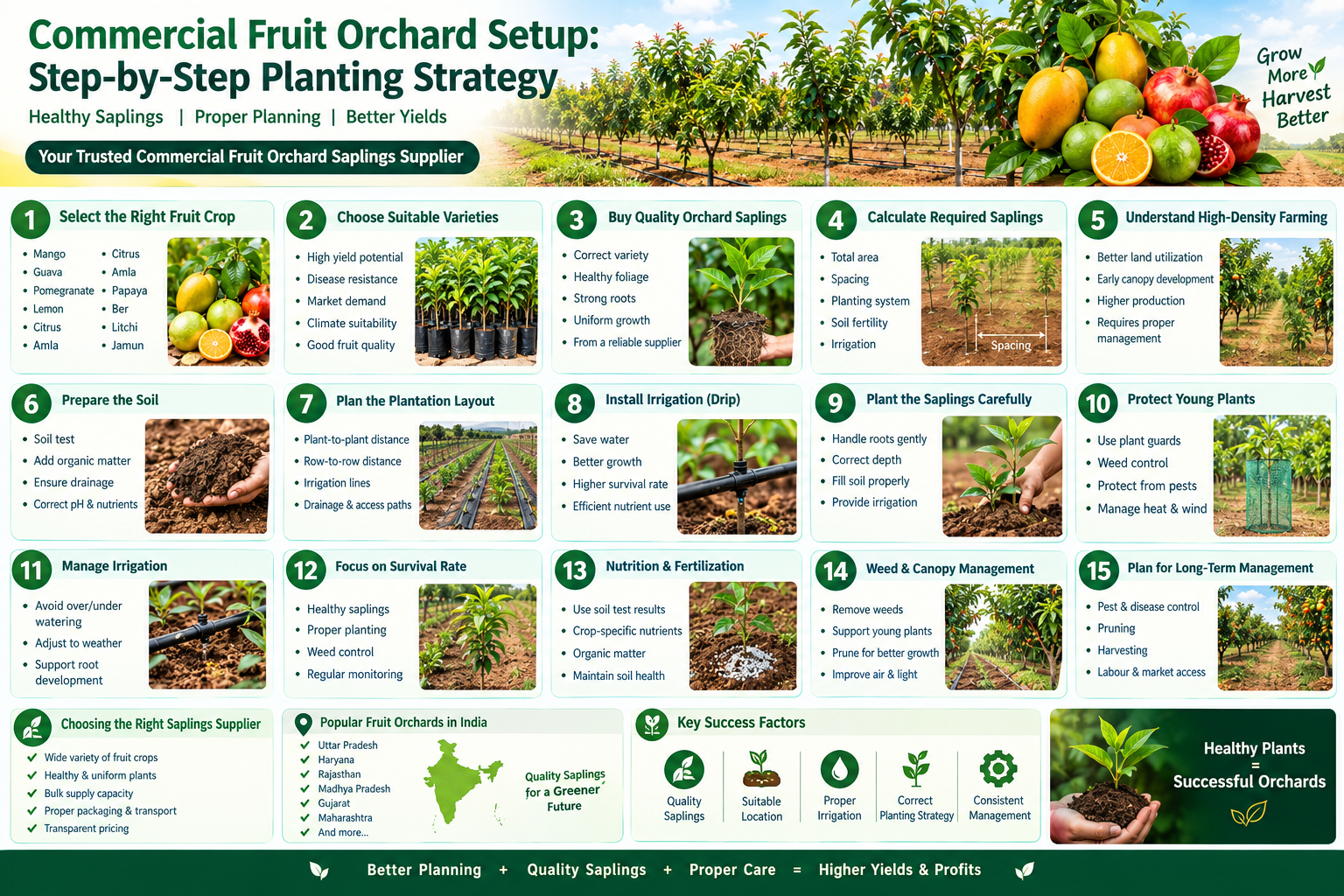
Starting a commercial fruit orchard requires much more than simply planting fruit trees on available land. A successful orchard depends on choosing suitable saplings, preparing the soil, planning plant spacing, installing irrigation, managing nutrition and protecting young plants during their establishment period.
For farmers, landowners, agri-businesses and commercial plantation projects, purchasing healthy plants from a reliable commercial fruit orchard saplings supplier is an important first step. The right planting material combined with proper orchard planning can improve establishment, uniform growth and long-term productivity.
Whether the orchard is based on mango, guava, lemon, citrus, pomegranate, amla or another fruit crop, the planting strategy should be designed according to the crop, climate, soil, water availability and intended production system.
What Is a Commercial Fruit Orchard?
A commercial fruit orchard is an agricultural area specifically planned for the systematic cultivation of fruit-bearing plants for commercial production.
Unlike a small home garden, a commercial orchard requires proper planning for:
- Land utilization
- Fruit variety selection
- Quality saplings
- Planting density
- Irrigation
- Fertilization
- Pest and disease management
- Pruning
- Harvesting
- Labour requirements
- Long-term orchard maintenance
The objective is to establish a healthy and manageable plantation that can provide consistent production over its productive life.
Step 1: Select the Right Fruit Crop
The first decision is selecting a fruit crop suitable for the location and business objective.
Popular commercial fruit crops may include:
- Mango
- Guava
- Pomegranate
- Lemon
- Orange and other citrus
- Amla
- Papaya
- Ber
- Litchi
- Jamun
However, popularity alone should not determine the choice.
Consider:
- Local climate
- Temperature
- Rainfall
- Soil type
- Water availability
- Market demand
- Transportation
- Harvesting season
- Labour availability
- Expected orchard life
A crop that performs well in one region may require a different management strategy in another.
Step 2: Choose Suitable Fruit Varieties
After selecting the crop, choose varieties according to local growing conditions and market requirements.
Different varieties can vary in:
- Fruit size
- Taste
- Harvest period
- Growth habit
- Disease tolerance
- Yield potential
- Market demand
- Climate suitability
For commercial plantations, buyers should discuss the intended orchard location and objective with a knowledgeable nursery or horticultural professional before ordering large quantities of saplings.
Step 3: Purchase Quality Orchard Saplings
The quality of planting material can have a major influence on orchard establishment.
When selecting a commercial fruit orchard saplings supplier, buyers should check:
- Correct variety
- Healthy foliage
- Strong stems
- Well-developed root systems
- Uniform plant growth
- Appropriate plant age or size
- Disease and pest condition
- Proper nursery management
- Availability of required quantities
For a large orchard, uniform planting material can make plantation management easier.
A commercial nursery should also be able to clearly communicate available quantities, plant sizes, packaging and transportation arrangements.
Step 4: Calculate the Required Number of Saplings
Before placing a bulk order, calculate how many plants are required for the available land.
The number of saplings depends on:
- Total orchard area
- Crop
- Variety
- Planting system
- Recommended spacing
- Soil fertility
- Irrigation
- Training and pruning system
Traditional orchards generally use wider spacing, while high-density fruit farming uses closer spacing and requires more intensive management.
Do not select spacing simply because it allows more plants per acre. The plants need adequate light, air circulation, root space and management access.
Step 5: Understand High-Density Fruit Farming
High-density planting involves growing a larger number of plants within a given area compared with conventional orchard systems.
Its potential advantages include:
- Better land utilization
- Earlier canopy development
- Easier management in some systems
- Potentially higher production per unit area
- Efficient use of irrigation and inputs
However, high-density orchards also require careful management.
Important considerations include:
- Suitable varieties and rootstocks
- Precise spacing
- Pruning
- Canopy management
- Irrigation
- Nutrition
- Pest and disease monitoring
Therefore, high-density planting should be implemented according to crop-specific recommendations rather than simply reducing the distance between plants.
Step 6: Prepare the Soil Before Planting
Soil preparation should be completed before the saplings arrive.
Evaluate:
- Soil type
- Soil depth
- Drainage
- pH
- Organic matter
- Nutrient status
- Water-holding capacity
- Compaction
A soil test can provide useful information about nutrient levels and soil pH.
If soil improvement is required, amendments should be applied according to test results and professional recommendations.
Good drainage is especially important because prolonged waterlogging can damage roots and negatively affect young fruit plants.
Step 7: Prepare the Plantation Layout
A commercial orchard should have a planned layout before planting begins.
Mark the planting points according to the selected spacing.
A good layout should consider:
- Plant-to-plant distance
- Row-to-row distance
- Irrigation lines
- Drainage
- Access paths
- Machinery movement
- Labour movement
- Future pruning and harvesting
A well-planned orchard layout makes routine management more efficient.
Step 8: Install Irrigation Before Planting
Water management is one of the most important factors in young orchard establishment.
Depending on the crop, location and farming system, irrigation may be provided through systems such as drip irrigation.
An irrigation plan should consider:
- Water source
- Water quality
- Orchard size
- Number of plants
- Seasonal water requirement
- Irrigation frequency
- Soil type
Drip irrigation can allow water to be delivered close to the plant’s root zone and can be integrated with commercial orchard management systems.
The irrigation system should ideally be planned and installed before or during orchard establishment.
Step 9: Plant the Saplings Carefully
Once the land, layout and irrigation system are ready, planting can begin.
During planting:
- Keep the saplings protected from excessive heat and drying.
- Prepare planting pits or planting locations according to crop recommendations.
- Handle the root system carefully.
- Place the plant at the appropriate depth.
- Fill the soil around the root zone properly.
- Avoid damaging the stem or roots.
- Provide irrigation according to the crop’s requirements.
- Support young plants where necessary.
The exact planting procedure can vary according to the fruit crop and planting material.
Step 10: Protect Young Plants After Planting
The first stage after planting is critical for orchard establishment.
Young saplings can be affected by:
- Heat
- Water stress
- Weeds
- Strong winds
- Grazing animals
- Pests
- Diseases
- Poor drainage
Depending on the orchard location, suitable measures may include plant guards, staking, mulching, weed control and appropriate irrigation.
Regular monitoring allows problems to be identified before they become widespread.
Step 11: Manage Irrigation for Better Survival
Plant survival depends heavily on appropriate water management during establishment.
Both insufficient and excessive irrigation can create problems.
Too little water can result in:
- Wilting
- Slow growth
- Leaf stress
- Poor establishment
Excessive irrigation can contribute to:
- Root problems
- Nutrient loss
- Waterlogging
- Poor soil aeration
Irrigation should therefore be adjusted according to plant age, crop, soil, weather and rainfall.
Step 12: Focus on Sapling Survival Rate
A commercial orchard is not successful simply because a large number of saplings were planted.
The objective should be to establish healthy plants with a strong root system and uniform growth.
To improve survival:
- Purchase healthy planting material
- Transport saplings carefully
- Avoid unnecessary delays between delivery and planting
- Prepare the land in advance
- Provide suitable irrigation
- Control weeds
- Protect young plants
- Monitor pests and diseases
- Replace plants that fail to establish when appropriate
Early orchard management can have a significant influence on future plant development.
Step 13: Nutrition and Fertilizer Management
Fruit plants require appropriate nutrients for vegetative growth, flowering and fruit development.
However, fertilizer should not be applied blindly.
A commercial orchard nutrition program should consider:
- Soil test results
- Crop requirements
- Plant age
- Growth stage
- Soil type
- Irrigation
- Local recommendations
Organic matter and suitable nutrient management can contribute to maintaining soil health.
For large orchards, keeping records of fertilizer applications can help improve long-term management.
Step 14: Weed Management
Weeds compete with young fruit plants for:
- Water
- Nutrients
- Space
- Sunlight
Effective weed management is therefore important, especially during the early stages of orchard development.
Methods may include appropriate mechanical, cultural or other recommended weed-management practices depending on the crop and farming system.
Keeping the immediate root-zone area properly managed can help young plants establish more effectively.
Step 15: Pruning and Canopy Management
Pruning becomes increasingly important as fruit plants develop.
The objective is to develop a suitable canopy structure that supports:
- Light penetration
- Air circulation
- Fruit production
- Harvesting
- Disease management
- Efficient orchard operations
High-density orchards generally require more careful canopy management because plants have less available space.
Pruning practices should be specific to the fruit crop and variety.
Step 16: Plan for Long-Term Orchard Management
A commercial orchard should be treated as a long-term agricultural project.
Before planting, consider future requirements such as:
- Irrigation maintenance
- Fertilizer application
- Pruning
- Pest management
- Harvesting
- Labour
- Storage
- Transportation
- Market access
Planning these requirements in advance can help avoid operational problems later.
How to Select a Commercial Fruit Orchard Saplings Supplier
Choosing the right nursery is an important part of commercial orchard planning.
Before ordering, ask the supplier:
- Which fruit varieties are available?
- Are the saplings suitable for commercial plantation?
- What plant sizes are available?
- How many saplings are currently available?
- Are the plants healthy and properly established?
- How are the plants packaged?
- Can bulk orders be supplied?
- How is transportation arranged?
- Can the nursery supply to the required location?
- What is the wholesale price for the required quantity?
For a large project, it is better to confirm availability and pricing before finalizing the plantation schedule.
Wholesale Pricing of Fruit Orchard Saplings
The wholesale price of fruit saplings can vary depending on several factors.
These may include:
- Fruit crop
- Variety
- Plant size
- Plant age
- Planting material
- Quantity ordered
- Container or bag size
- Nursery production costs
- Packaging
- Transportation
- Seasonal availability
For this reason, commercial buyers should request a customized quotation instead of relying on a general retail price.
A bulk order of several hundred or several thousand plants may have different commercial pricing from individual retail purchases.
Bulk Fruit Sapling Procurement Process
A practical commercial procurement process can be:
1. Select the crop
Choose a fruit crop suitable for the site.
2. Select the variety
Consider climate, market and production objectives.
3. Measure the land
Determine the available plantation area.
4. Finalize spacing
Choose the appropriate planting system.
5. Calculate quantity
Estimate the required number of saplings.
6. Contact a commercial fruit orchard saplings supplier
Share crop, variety, quantity, location and plant size requirements.
7. Confirm quotation
Review plant pricing, packaging and transportation costs.
8. Prepare the land
Complete soil preparation, layout and irrigation.
9. Receive the saplings
Inspect the plants after delivery.
10. Plant and establish
Plant according to crop-specific recommendations and begin orchard management.
Commercial Fruit Orchard Planning in India
India has a wide range of climates and agricultural conditions, making location-specific orchard planning important.
Commercial fruit plantations may be developed in different regions, including Uttar Pradesh, Haryana, Rajasthan, Madhya Pradesh, Gujarat, Maharashtra and other states.
However, the same fruit crop and planting system may not perform identically in every location.
Before ordering saplings in bulk, evaluate:
- Local climate
- Soil conditions
- Water availability
- Fruit variety
- Market demand
- Transportation
- Crop management requirements
Local horticultural recommendations should be considered when making major commercial plantation decisions.
Conclusion
A successful commercial fruit orchard begins with proper planning.
Selecting the right fruit crop and variety, purchasing healthy saplings, calculating suitable plant density, preparing the soil, installing irrigation and managing young plants carefully can improve orchard establishment and support long-term productivity.
For farmers and commercial plantation projects, finding a reliable commercial fruit orchard saplings supplier is an important part of the procurement process. The supplier should be able to provide suitable planting material in the required quantity and communicate clearly about plant size, availability, pricing, packaging and transportation.
High-density fruit farming can provide efficient use of land, but it requires careful spacing, irrigation, pruning, nutrition and canopy management.
Ultimately, the success of a commercial orchard depends on combining quality saplings + suitable site selection + proper irrigation + correct planting strategy + consistent orchard management.
Frequently Asked Questions
What is a commercial fruit orchard?
A commercial fruit orchard is an agricultural plantation designed for systematic fruit production and commercial sales. It requires planned planting, irrigation, nutrition, pest management and harvesting.
How do I choose a commercial fruit orchard saplings supplier?
Look for a supplier that can provide the required fruit varieties and quantities, healthy planting material, suitable plant sizes, proper packaging and reliable transportation for bulk orders.
What is high-density fruit farming?
High-density fruit farming involves planting a greater number of fruit plants per unit area than conventional systems. It requires suitable varieties, planned spacing, irrigation, pruning and careful canopy management.
How can I improve fruit sapling survival rates?
Start with healthy planting material, prepare the land properly, handle saplings carefully during transportation and planting, provide appropriate irrigation and monitor young plants regularly.