
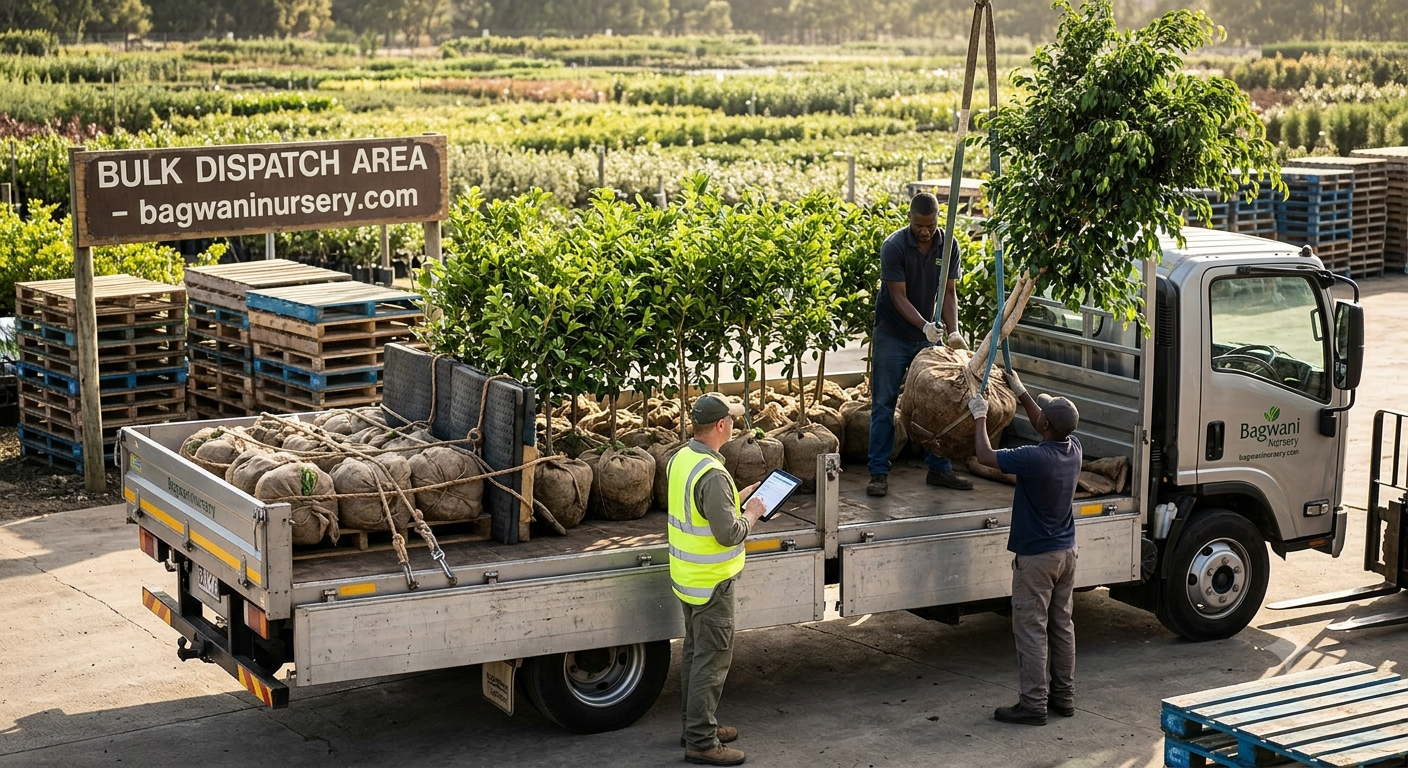
Transporting nursery plants safely is an important part of commercial plant supply. When plants are ordered in bulk for landscaping companies, developers, hotels, institutions, retailers, or other businesses, proper handling and transportation can directly affect plant quality and customer satisfaction.
Unlike ordinary goods, live plants are sensitive to temperature, moisture loss, physical damage, poor ventilation, and rough handling. A professional bulk plant supply logistics for nurseries system should therefore cover everything from pre-dispatch inspection to loading, transportation, unloading, and post-delivery handling.
This Standard Operating Procedure (SOP) provides a practical framework for nurseries and B2B buyers managing commercial plant shipments.
Why Safe Plant Transportation Matters
Plants can experience stress during transportation even when they leave the nursery in excellent condition.
Common transportation problems include:
- Broken branches
- Damaged foliage
- Crushed stems
- Soil or growing-media loss
- Dehydration
- Root disturbance
- Overheating
- Poor ventilation
- Pot breakage
- Improper stacking
- Delayed delivery
For large B2B orders, even a small percentage of damaged plants can create additional replacement costs and affect project timelines.
A standardized handling procedure helps reduce these risks.
1. Conduct a Pre-Dispatch Plant Inspection
Before plants are packed and loaded, the nursery team should inspect the order against the customer’s specifications.
The inspection should verify:
- Plant variety
- Quantity
- Plant size
- Pot or container size
- Overall plant health
- Foliage condition
- Root condition where appropriate
- Pest or disease symptoms
- Physical damage
- Moisture level
Plants that are visibly damaged, severely stressed, or unsuitable for dispatch should be separated before loading.
This step is particularly important for commercial orders where the buyer may require uniform plant quality across hundreds or thousands of units.
2. Prepare Plants According to Their Type
Different plants require different handling methods.
Small Potted Plants
Small plants should be organized securely to prevent pots from tipping over during transportation.
Shrubs and Ornamental Plants
Shrubs should have sufficient space to prevent excessive compression of branches and foliage.
Flowering Plants
Flowering plants may require additional protection because flowers and soft stems can be easily damaged.
Palms and Large Plants
Large plants require careful support and adequate space during loading. Their containers should be secured to prevent movement.
Trees and Large Nursery Stock
Trees should be handled using appropriate lifting and support methods. Branches and trunks should not be subjected to unnecessary pressure.
3. Water Plants Appropriately Before Dispatch
Water management before transportation is an important part of plant logistics.
Plants should generally be in suitable moisture condition before dispatch. However, excessive watering immediately before loading can create additional weight and may increase the risk of growing-media movement or leakage.
The ideal watering schedule depends on:
- Plant species
- Weather
- Container size
- Growing medium
- Transportation duration
- Destination climate
Nursery teams should plan watering according to the expected dispatch and travel period rather than following the same procedure for every plant.
4. Use Appropriate Packaging
Packaging should protect plants while still allowing sufficient ventilation.
Depending on the plant type, nurseries may use:
- Plant trays
- Protective sleeves
- Corrugated supports
- Boxes for suitable small plants
- Secure containers
- Soft ties
- Protective wrapping
- Pallet systems where appropriate
Packaging should never unnecessarily compress leaves, flowers, stems, or branches.
For long-distance B2B shipments, packaging quality becomes particularly important because plants may remain in transit for extended periods.
5. Label Bulk Orders Clearly
Large commercial shipments should be properly identified before loading.
Useful shipment information includes:
- Customer name or order reference
- Plant category
- Quantity
- Destination
- Loading date
- Delivery instructions
- Special handling requirements
Clear labeling helps prevent mixing different varieties or customer orders during dispatch.
For large shipments containing multiple plant categories, organized labeling can significantly improve unloading efficiency.
6. Follow a Safe Loading Procedure
Loading should be performed carefully rather than simply maximizing the number of plants inside the vehicle.
The loading team should consider:
- Plant height
- Container stability
- Weight distribution
- Available ventilation
- Protection from compression
- Vehicle capacity
- Accessibility during unloading
Heavy containers should be positioned securely, while delicate plants should not be placed underneath heavier items.
Plants should also be secured sufficiently to prevent excessive movement during sudden braking, turns, or uneven road conditions.
7. Avoid Excessive Stacking
One of the most common causes of transportation damage is improper stacking.
Stacking should only be used when the plant and container design allows it.
Avoid:
- Crushing foliage
- Placing heavy pots over delicate plants
- Blocking ventilation
- Creating unstable stacks
- Putting fragile flowering plants underneath heavier material
The objective should be safe utilization of vehicle space, not maximum loading density.
8. Maintain Adequate Ventilation
Plants continue to respire during transportation.
Poor ventilation can contribute to heat and humidity buildup, particularly when a vehicle is heavily loaded.
For suitable shipments, the transport setup should provide adequate airflow while protecting plants from excessive exposure to harsh environmental conditions.
The exact transportation arrangement should depend on:
- Plant species
- Season
- Journey duration
- Vehicle type
- Route conditions
- Destination climate
During hot weather, additional planning may be required to reduce heat stress.
9. Plan Transportation Routes Carefully
Logistics planning is not only about selecting a vehicle.
Before dispatch, the nursery should consider:
- Total distance
- Expected travel time
- Road conditions
- Weather conditions
- Traffic
- Delivery location
- Loading and unloading points
- Customer receiving schedule
For long-distance shipments, route planning can help minimize unnecessary delays and handling.
A shorter or more predictable route may sometimes be preferable to a route that appears shorter but has difficult road conditions.
10. Select the Right Vehicle
Vehicle selection should be based on the type and volume of nursery stock.
Factors to consider include:
- Shipment size
- Plant height
- Container dimensions
- Ventilation requirements
- Distance
- Weather
- Loading method
- Unloading requirements
The vehicle should have sufficient capacity to transport the order without excessive compression or unsafe stacking.
11. Maintain a Dispatch Checklist
A standardized dispatch checklist can reduce mistakes.
Pre-Dispatch Checklist
☐ Order quantity verified
☐ Plant varieties verified
☐ Plant sizes checked
☐ Plant health inspected
☐ Containers checked
☐ Moisture condition reviewed
☐ Packaging completed
☐ Labels attached
☐ Vehicle inspected
☐ Loading plan prepared
☐ Destination confirmed
☐ Customer delivery timing confirmed
Using a checklist ensures that important steps are not skipped during busy dispatch periods.
12. Document the Shipment
For professional B2B operations, documentation should accompany the physical shipment.
Depending on the order, documentation may include:
- Invoice
- Packing list
- Dispatch details
- Plant quantity records
- Transport information
- Customer order reference
- Special handling instructions
Maintaining accurate records helps both the nursery and buyer resolve quantity or delivery-related questions.
For interstate or regulated plant movement, businesses should also verify any applicable documentation and phytosanitary requirements before dispatch.
13. Handle Plants Carefully During Unloading
Safe transportation does not end when the vehicle reaches the destination.
The unloading team should:
- Inspect the shipment before unloading.
- Remove plants carefully.
- Avoid dragging containers unnecessarily.
- Keep plants upright where appropriate.
- Move plants to a suitable temporary holding area.
- Check for visible transportation damage.
- Confirm quantities against the packing list.
For large landscaping projects, plants should ideally be transferred to their designated planting or holding areas as soon as practical.
14. Inspect Plants After Delivery
The buyer or receiving team should inspect the shipment after unloading.
The inspection can record:
- Total quantity received
- Missing plants
- Damaged plants
- Broken containers
- Foliage condition
- General plant condition
- Packaging condition
Photographs can also be useful for documenting the condition of a shipment at the time of delivery.
A clear receiving process helps both parties resolve issues quickly.
15. Create a Damage Reporting Procedure
If damage occurs during transportation, the issue should be documented systematically.
A simple process can include:
Step 1: Identify damaged plants.
Step 2: Separate them from healthy stock.
Step 3: Record quantities.
Step 4: Take photographs where appropriate.
Step 5: Inform the supplier or logistics coordinator.
Step 6: Compare the condition with dispatch records.
Step 7: Determine replacement or resolution requirements.
This creates transparency between the nursery, logistics provider, and B2B customer.
Common Plant Transportation Mistakes
Commercial nurseries should avoid several common logistics mistakes:
Overloading the Vehicle
Trying to transport too many plants in one shipment can cause compression and physical damage.
Poor Ventilation
Insufficient airflow can increase stress during transportation.
Inadequate Securing
Unsecured plants and containers may shift during transit.
Incorrect Watering
Both excessive and insufficient moisture before transportation can create problems.
Poor Route Planning
Unexpected delays can increase transportation stress.
Weak Documentation
Incorrect quantities or mixed orders can create unnecessary disputes.
Last-Minute Dispatch Planning
Rushed loading often increases the probability of handling errors.
Building an Efficient B2B Plant Logistics System
A reliable nursery logistics system should connect inventory, quality control, packaging, transportation, documentation, and customer receiving into one process.
A practical workflow can look like this:
Order Received → Plant Availability Checked → Quality Inspection → Order Preparation → Packaging → Labeling → Vehicle Planning → Loading → Dispatch → Transit Monitoring → Delivery → Receiving Inspection
This structured approach can help nurseries handle larger commercial orders more efficiently.
Why SOPs Are Important for Bulk Plant Supply
As a nursery grows, relying only on individual employee experience can create inconsistent results.
A written SOP provides a repeatable process that new and existing staff can follow.
Benefits include:
- More consistent plant handling
- Lower risk of transportation damage
- Better staff coordination
- Faster order preparation
- Improved customer communication
- Easier quality control
- Better scalability for large orders
For nurseries serving landscaping contractors, developers, retailers, and institutional buyers, standardized logistics can become an important competitive advantage.
Final Thoughts
Safe transportation of commercial nursery stock requires planning at every stage, from plant selection and pre-dispatch inspection to packaging, loading, transportation, unloading, and final inspection.
For businesses involved in bulk plant supply logistics for nurseries, a well-defined SOP can help reduce avoidable damage, improve operational consistency, and create a more reliable B2B supply process.
The ultimate objective is simple: plants should leave the nursery healthy, travel safely, and arrive at the customer’s location in the best practical condition.