
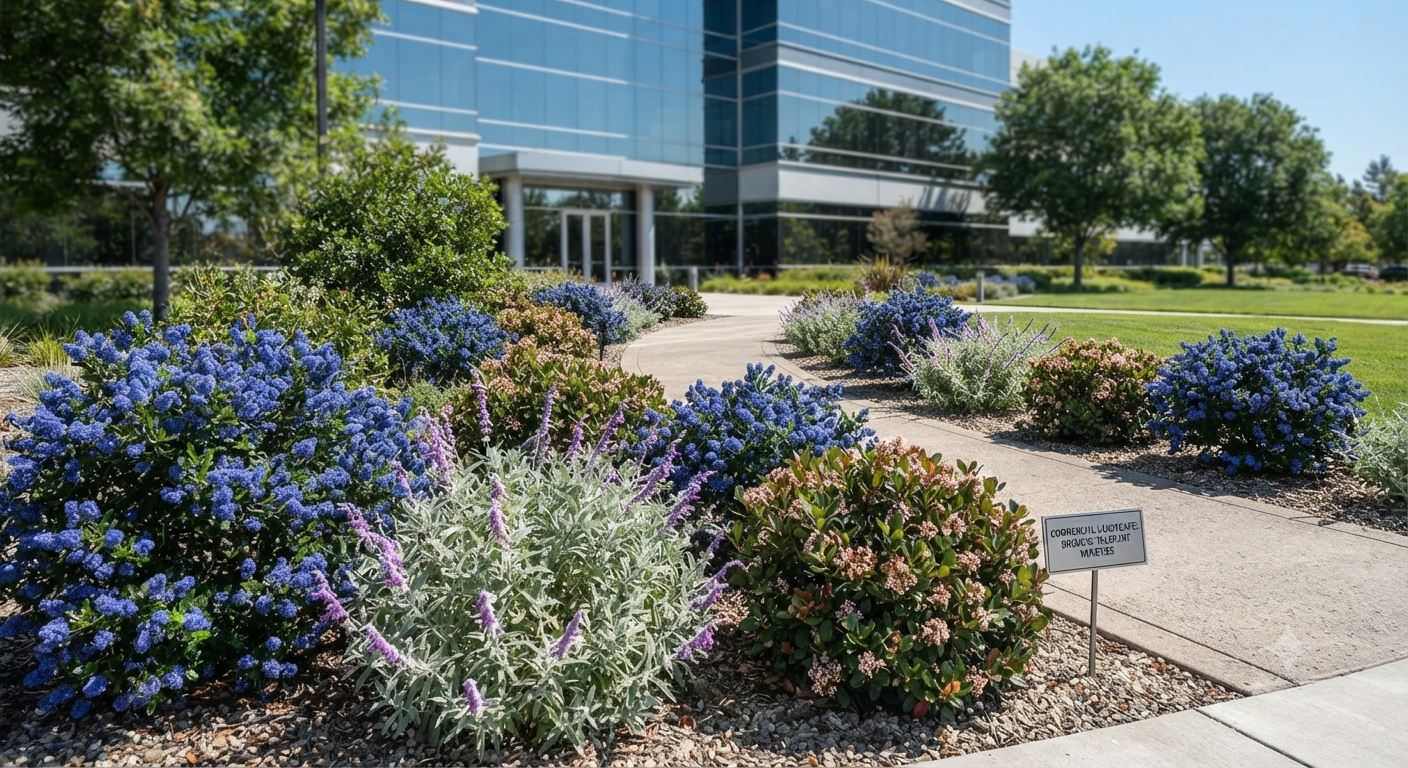
Corporate campuses are no longer designed only around buildings, parking areas and pathways. Modern commercial properties increasingly use professionally planned landscapes to create an attractive environment for employees, visitors and clients. However, maintaining large green spaces can become expensive when landscapes require frequent irrigation, pruning and replacement.
This is why commercial landscaping drought tolerant shrubs are becoming an important choice for corporate campuses, office complexes, hotels, educational institutions, industrial parks and other large properties.
Drought-tolerant shrubs can help landscape designers create structured green spaces while reducing dependence on frequent watering. When the right plants are selected according to local climate, soil and sunlight conditions, they can provide year-round landscape value with comparatively lower irrigation requirements.
For commercial landscape projects, the objective should not simply be to choose plants that survive dry conditions. The better approach is to select shrubs that combine water efficiency, appearance, durability, growth habit and maintenance practicality.
Why Drought-Tolerant Shrubs Are Becoming Popular in Commercial Landscaping
Large commercial landscapes can cover thousands of square feet or even several acres. Maintaining such spaces requires a systematic approach to irrigation and plant management.
Traditional landscapes may depend heavily on regular watering, particularly during hot and dry periods. This can increase maintenance requirements and operating costs.
Drought-tolerant shrubs offer an alternative for suitable landscape zones.
Some important advantages include:
- Reduced irrigation requirements after establishment
- Lower water dependency
- Better suitability for hot and dry conditions
- Reduced replacement requirements when correctly selected
- Attractive foliage and flowering options
- Useful for creating borders and visual screening
- Suitable for parking areas, walkways and building entrances
- Better integration with sustainable landscaping strategies
However, drought tolerance does not mean that a shrub requires zero water. Newly planted shrubs normally need regular irrigation while their root systems become established.
What Makes a Shrub Suitable for Corporate Campuses?
Selecting shrubs for a corporate landscape requires more consideration than selecting plants for a residential garden.
Commercial properties usually need plants that can handle:
- Large planting areas
- Different levels of sunlight
- Regular pedestrian activity
- Heat reflected from buildings and paved surfaces
- Limited maintenance windows
- Long-term landscape planning
- Consistent visual appearance
Planting should therefore be based on the site’s microclimate and landscape design.
For example, a shrub suitable for an open sunny lawn may not perform equally well in a shaded entrance area.
Best Drought-Tolerant Shrubs for Commercial Landscaping
The following shrub categories can be considered for suitable commercial landscape projects. Exact performance depends on climate, soil, irrigation, exposure and plant establishment.
1. Bougainvillea
Bougainvillea is one of the popular choices for warm-climate commercial landscapes.
Its colorful bracts can create strong visual impact around:
- Corporate entrances
- Boundary walls
- Security areas
- Parking zones
- Walkways
- Feature landscapes
Once established, bougainvillea can tolerate relatively dry conditions and strong sunlight.
For commercial projects, it can also be trained and maintained according to the required landscape design.
Procurement consideration: Select healthy, well-rooted plants with uniform growth when purchasing in bulk for a large project.
2. Duranta
Duranta is frequently used in tropical and subtropical landscaping for hedges, borders and screening.
Depending on the selected variety, it can provide dense foliage and can be shaped through regular pruning.
It can be useful for:
- Roadside landscaping
- Campus boundaries
- Parking-area screening
- Formal hedges
- Institutional landscapes
For large projects, uniform plant height and size can help create a more consistent finished landscape.
3. Tecoma
Tecoma is another option for warm-climate landscapes where flowering shrubs are required.
Its flowering display can add color to otherwise green landscape areas.
Tecoma can be considered for:
- Building perimeters
- Roadside planting
- Open landscape zones
- Corporate gardens
- Institutional campuses
Its final placement should account for available sunlight and space because mature plant size can vary by species and cultivar.
4. Hibiscus
Hibiscus is commonly used in commercial and institutional landscapes because of its attractive flowers and availability in different forms.
It can work particularly well where landscape designers want flowering elements near:
- Entrances
- Pathways
- Reception areas
- Garden seating
- Open campus areas
Although hibiscus generally benefits from adequate moisture, selecting the right planting location and irrigation strategy can make it part of a water-conscious landscape.
Therefore, it should be categorized as a moderate-water landscape option in many settings, rather than assuming every hibiscus variety is highly drought tolerant.
5. Nerium Oleander
Nerium oleander is known for its tolerance of heat and relatively dry conditions once established.
It can be useful for larger commercial landscapes where a durable flowering shrub is required.
Potential applications include:
- Dividers
- Roadside landscaping
- Large campuses
- Industrial properties
- Landscape screening
However, oleander is toxic if ingested, so landscape planners should consider site use, accessibility and safety before selecting it for a project.
6. Carissa
Carissa varieties can be useful where dense foliage, structure and low-maintenance landscaping are desired.
They can work well as:
- Boundary planting
- Security hedges
- Landscape borders
- Foundation planting
- Commercial property screening
Carissa can also provide a strong green appearance when managed appropriately.
7. Clerodendrum
Certain Clerodendrum varieties can be considered for warm-climate landscape applications where flowering and foliage are important.
They can be incorporated into mixed shrub beds rather than relying on a single plant species throughout the entire campus.
This approach creates visual diversity and can also reduce the risk of an entire landscape section looking damaged if one plant type experiences a pest or disease problem.
How to Choose Drought-Tolerant Shrubs for Corporate Campuses
Choosing plants solely on the basis of a “drought tolerant” label is not enough.
A professional commercial landscaping plan should consider several factors.
1. Climate
Temperature, rainfall patterns and seasonal extremes should be evaluated before selecting plants.
A shrub that performs well in one region may require considerably more irrigation in another.
2. Sunlight
Identify whether each planting zone receives:
- Full sun
- Partial sun
- Filtered light
- Shade
Plant requirements should match the actual site conditions.
3. Soil
Soil drainage and fertility can significantly affect plant establishment.
Poorly drained soil can cause root problems even when a plant is otherwise suitable for dry conditions.
4. Mature Size
Landscape planners should consider the mature height and spread rather than selecting plants only according to their nursery size.
This helps avoid overcrowding and excessive pruning later.
5. Maintenance Requirements
A commercial property may have a fixed landscaping maintenance budget.
Shrubs requiring frequent trimming may increase long-term maintenance costs.
6. Visual Design
A successful commercial landscape needs more than plant survival.
Plants should contribute to the property’s overall design through:
- Foliage color
- Flowering
- Texture
- Height
- Shape
- Seasonal interest
Drought-Tolerant Shrubs for Different Commercial Landscape Zones
One of the best approaches is to divide the property into landscape zones.
| Landscape Zone | Suitable Plant Characteristics |
|---|---|
| Main Entrance | Attractive flowering or structured shrubs |
| Parking Area | Heat-tolerant, durable plants |
| Boundary | Dense shrubs suitable for screening |
| Walkways | Compact, controlled growth |
| Building Perimeter | Low-maintenance foundation plants |
| Large Open Areas | Hardy shrubs requiring less irrigation |
| Security Zone | Dense, manageable hedge plants |
This zoning strategy allows landscape designers to select plants according to their actual environmental conditions instead of using one shrub throughout the property.
Commercial Landscaping Trends in 2026
Commercial landscaping is increasingly moving toward practical and resource-efficient design.
Howdy, bagwaninursery

Some important trends include:
Water-Efficient Landscape Planning
Businesses are looking for landscapes that remain attractive without depending excessively on irrigation.
Native and Climate-Adapted Plants
Where appropriate, landscape designers are giving greater attention to plants adapted to local environmental conditions.
Layered Planting
Instead of using only lawns, commercial landscapes increasingly combine trees, shrubs, groundcovers and ornamental plants.
This creates visual depth while reducing dependence on large areas of turf.
Smart Irrigation
Drip irrigation, moisture monitoring and automated irrigation systems can help deliver water more efficiently.
Low-Maintenance Corporate Landscapes
Businesses increasingly prefer landscapes that look professional without requiring intensive daily maintenance.
Why Bulk Procurement Matters for Large Landscaping Projects
A corporate campus may require hundreds or thousands of plants.
Purchasing plants individually from multiple retail nurseries can create problems related to:
- Plant size variation
- Availability
- Delivery scheduling
- Quality consistency
- Documentation
- Transportation
- Replacement stock
Working with a commercial nursery supplier can make bulk procurement more organized.
Before placing a large order, buyers should ask the nursery about:
- Available plant varieties
- Plant height and pot size
- Root development
- Quantity available
- Bulk pricing
- Delivery locations
- Transportation arrangements
- Replacement policy
- Expected dispatch schedule
For large projects, it is also useful to request current plant photographs or a nursery stock list before finalizing procurement.
How to Reduce Water Requirements After Planting
Even drought-tolerant shrubs need appropriate establishment care.
A commercial landscaping team can use several strategies.
Use Mulching
Organic or suitable landscape mulch can help reduce moisture loss from soil.
Improve Soil Preparation
Proper soil preparation supports root development and drainage.
Use Drip Irrigation
Drip systems can deliver water closer to the root zone and may reduce unnecessary water application.
Group Plants According to Water Needs
Plants with similar irrigation requirements should ideally be grouped together.
This is known as hydrozoning and can make irrigation management more efficient.
Avoid Overwatering
More water does not necessarily mean faster or healthier growth. Irrigation should be adjusted according to plant establishment, soil conditions and weather.
Drought-Tolerant Shrubs vs Traditional Shrub Landscaping
The biggest difference is not necessarily the appearance of the landscape but its resource requirements and plant selection strategy.
A conventional landscape may use plants based primarily on visual preference.
A water-conscious commercial landscape considers:
Appearance + Climate + Water Requirement + Maintenance + Mature Size + Site Conditions
This creates a more sustainable approach to commercial landscape planning.
Common Mistakes When Selecting Drought-Tolerant Shrubs
Choosing Plants Only Because They Are Advertised as Drought Tolerant
Actual performance depends on local growing conditions.
Ignoring Establishment Irrigation
New plants still require sufficient water while roots establish.
Planting Too Closely
Small nursery plants can become significantly larger as they mature.
Using the Same Plant Everywhere
Monoculture can reduce visual diversity and may increase landscape vulnerability to pests and diseases.
Ignoring Maintenance
Even hardy shrubs may require pruning, fertilization and pest monitoring.
Frequently Asked Questions
What are the best drought-tolerant shrubs for commercial landscaping?
Suitable options depend on climate and site conditions. Bougainvillea, Duranta, Tecoma, Carissa and certain other heat-tolerant shrubs can be considered for appropriate commercial landscapes.
Are drought-tolerant shrubs completely maintenance free?
No. Drought-tolerant plants still require establishment irrigation, pruning, pest monitoring and occasional maintenance.
Are drought-tolerant shrubs suitable for corporate campuses?
Yes. When correctly selected and planted according to site conditions, they can be useful for corporate campuses, offices, hotels, institutions and other commercial properties.
How many shrubs should I order for a commercial project?
The quantity depends on the total planting area, plant variety, mature size and required spacing. A landscape plan or planting schedule should be prepared before bulk procurement.
Can I buy drought-tolerant shrubs in bulk?
Yes. Commercial nurseries can supply shrubs in bulk depending on availability, season and required specifications. Large buyers should confirm quantity, plant size and delivery requirements before ordering.
Do drought-tolerant shrubs need irrigation?
Yes, especially during the establishment period. Once established, suitable drought-tolerant plants may require less supplemental irrigation than plants with higher water requirements.
Conclusion
The demand for commercial landscaping drought tolerant shrubs is closely connected with the growing focus on water-efficient, practical and visually attractive commercial landscapes.
For corporate campuses and large institutional properties, the best plant selection is not simply the shrub that requires the least water. The ideal choice balances climate suitability, appearance, mature size, maintenance requirements, durability and irrigation needs.
For B2B landscaping projects, bulk procurement from a reliable nursery can also simplify sourcing and help maintain consistency across large planting areas.
If you are planning a corporate campus, hotel, institutional landscape or large commercial project, prepare the planting requirement first and then source shrubs according to the project’s climate, landscape zones and required quantities.
This is why commercial landscaping drought tolerant shrubs are becoming an important choice for corporate campuses, office complexes, hotels, educational institutions, industrial parks and other large properties.
Drought-tolerant shrubs can help landscape designers create structured green spaces while reducing dependence on frequent watering. When the right plants are selected according to local climate, soil and sunlight conditions, they can provide year-round landscape value with comparatively lower irrigation requirements.
For commercial landscape projects, the objective should not simply be to choose plants that survive dry conditions. The better approach is to select shrubs that combine water efficiency, appearance, durability, growth habit and maintenance practicality.
Why Drought-Tolerant Shrubs Are Becoming Popular in Commercial Landscaping
Large commercial landscapes can cover thousands of square feet or even several acres. Maintaining such spaces requires a systematic approach to irrigation and plant management.
Traditional landscapes may depend heavily on regular watering, particularly during hot and dry periods. This can increase maintenance requirements and operating costs.
Drought-tolerant shrubs offer an alternative for suitable landscape zones.
Some important advantages include:
- Reduced irrigation requirements after establishment
- Lower water dependency
- Better suitability for hot and dry conditions
- Reduced replacement requirements when correctly selected
- Attractive foliage and flowering options
- Useful for creating borders and visual screening
- Suitable for parking areas, walkways and building entrances
- Better integration with sustainable landscaping strategies
However, drought tolerance does not mean that a shrub requires zero water. Newly planted shrubs normally need regular irrigation while their root systems become established.
What Makes a Shrub Suitable for Corporate Campuses?
Selecting shrubs for a corporate landscape requires more consideration than selecting plants for a residential garden.
Commercial properties usually need plants that can handle:
- Large planting areas
- Different levels of sunlight
- Regular pedestrian activity
- Heat reflected from buildings and paved surfaces
- Limited maintenance windows
- Long-term landscape planning
- Consistent visual appearance
Planting should therefore be based on the site’s microclimate and landscape design.
For example, a shrub suitable for an open sunny lawn may not perform equally well in a shaded entrance area.
Best Drought-Tolerant Shrubs for Commercial Landscaping
The following shrub categories can be considered for suitable commercial landscape projects. Exact performance depends on climate, soil, irrigation, exposure and plant establishment.
1. Bougainvillea
Bougainvillea is one of the popular choices for warm-climate commercial landscapes.
Its colorful bracts can create strong visual impact around:
- Corporate entrances
- Boundary walls
- Security areas
- Parking zones
- Walkways
- Feature landscapes
Once established, bougainvillea can tolerate relatively dry conditions and strong sunlight.
For commercial projects, it can also be trained and maintained according to the required landscape design.
Procurement consideration: Select healthy, well-rooted plants with uniform growth when purchasing in bulk for a large project.
2. Duranta
Duranta is frequently used in tropical and subtropical landscaping for hedges, borders and screening.
Depending on the selected variety, it can provide dense foliage and can be shaped through regular pruning.
It can be useful for:
- Roadside landscaping
- Campus boundaries
- Parking-area screening
- Formal hedges
- Institutional landscapes
For large projects, uniform plant height and size can help create a more consistent finished landscape.
3. Tecoma
Tecoma is another option for warm-climate landscapes where flowering shrubs are required.
Its flowering display can add color to otherwise green landscape areas.
Tecoma can be considered for:
- Building perimeters
- Roadside planting
- Open landscape zones
- Corporate gardens
- Institutional campuses
Its final placement should account for available sunlight and space because mature plant size can vary by species and cultivar.
4. Hibiscus
Hibiscus is commonly used in commercial and institutional landscapes because of its attractive flowers and availability in different forms.
It can work particularly well where landscape designers want flowering elements near:
- Entrances
- Pathways
- Reception areas
- Garden seating
- Open campus areas
Although hibiscus generally benefits from adequate moisture, selecting the right planting location and irrigation strategy can make it part of a water-conscious landscape.
Therefore, it should be categorized as a moderate-water landscape option in many settings, rather than assuming every hibiscus variety is highly drought tolerant.
5. Nerium Oleander
Nerium oleander is known for its tolerance of heat and relatively dry conditions once established.
It can be useful for larger commercial landscapes where a durable flowering shrub is required.
Potential applications include:
- Dividers
- Roadside landscaping
- Large campuses
- Industrial properties
- Landscape screening
However, oleander is toxic if ingested, so landscape planners should consider site use, accessibility and safety before selecting it for a project.
6. Carissa
Carissa varieties can be useful where dense foliage, structure and low-maintenance landscaping are desired.
They can work well as:
- Boundary planting
- Security hedges
- Landscape borders
- Foundation planting
- Commercial property screening
Carissa can also provide a strong green appearance when managed appropriately.
7. Clerodendrum
Certain Clerodendrum varieties can be considered for warm-climate landscape applications where flowering and foliage are important.
They can be incorporated into mixed shrub beds rather than relying on a single plant species throughout the entire campus.
This approach creates visual diversity and can also reduce the risk of an entire landscape section looking damaged if one plant type experiences a pest or disease problem.
How to Choose Drought-Tolerant Shrubs for Corporate Campuses
Choosing plants solely on the basis of a “drought tolerant” label is not enough.
A professional commercial landscaping plan should consider several factors.
1. Climate
Temperature, rainfall patterns and seasonal extremes should be evaluated before selecting plants.
A shrub that performs well in one region may require considerably more irrigation in another.
2. Sunlight
Identify whether each planting zone receives:
- Full sun
- Partial sun
- Filtered light
- Shade
Plant requirements should match the actual site conditions.
3. Soil
Soil drainage and fertility can significantly affect plant establishment.
Poorly drained soil can cause root problems even when a plant is otherwise suitable for dry conditions.
4. Mature Size
Landscape planners should consider the mature height and spread rather than selecting plants only according to their nursery size.
This helps avoid overcrowding and excessive pruning later.
5. Maintenance Requirements
A commercial property may have a fixed landscaping maintenance budget.
Shrubs requiring frequent trimming may increase long-term maintenance costs.
6. Visual Design
A successful commercial landscape needs more than plant survival.
Plants should contribute to the property’s overall design through:
- Foliage color
- Flowering
- Texture
- Height
- Shape
- Seasonal interest
Drought-Tolerant Shrubs for Different Commercial Landscape Zones
One of the best approaches is to divide the property into landscape zones.
| Landscape Zone | Suitable Plant Characteristics |
|---|---|
| Main Entrance | Attractive flowering or structured shrubs |
| Parking Area | Heat-tolerant, durable plants |
| Boundary | Dense shrubs suitable for screening |
| Walkways | Compact, controlled growth |
| Building Perimeter | Low-maintenance foundation plants |
| Large Open Areas | Hardy shrubs requiring less irrigation |
| Security Zone | Dense, manageable hedge plants |
This zoning strategy allows landscape designers to select plants according to their actual environmental conditions instead of using one shrub throughout the property.
Commercial Landscaping Trends in 2026
Commercial landscaping is increasingly moving toward practical and resource-efficient design.
Some important trends include:
Water-Efficient Landscape Planning
Businesses are looking for landscapes that remain attractive without depending excessively on irrigation.
Native and Climate-Adapted Plants
Where appropriate, landscape designers are giving greater attention to plants adapted to local environmental conditions.
Layered Planting
Instead of using only lawns, commercial landscapes increasingly combine trees, shrubs, groundcovers and ornamental plants.
This creates visual depth while reducing dependence on large areas of turf.
Smart Irrigation
Drip irrigation, moisture monitoring and automated irrigation systems can help deliver water more efficiently.
Low-Maintenance Corporate Landscapes
Businesses increasingly prefer landscapes that look professional without requiring intensive daily maintenance.
Why Bulk Procurement Matters for Large Landscaping Projects
A corporate campus may require hundreds or thousands of plants.
Purchasing plants individually from multiple retail nurseries can create problems related to:
- Plant size variation
- Availability
- Delivery scheduling
- Quality consistency
- Documentation
- Transportation
- Replacement stock
Working with a commercial nursery supplier can make bulk procurement more organized.
Before placing a large order, buyers should ask the nursery about:
- Available plant varieties
- Plant height and pot size
- Root development
- Quantity available
- Bulk pricing
- Delivery locations
- Transportation arrangements
- Replacement policy
- Expected dispatch schedule
For large projects, it is also useful to request current plant photographs or a nursery stock list before finalizing procurement.
How to Reduce Water Requirements After Planting
Even drought-tolerant shrubs need appropriate establishment care.
A commercial landscaping team can use several strategies.
Use Mulching
Organic or suitable landscape mulch can help reduce moisture loss from soil.
Improve Soil Preparation
Proper soil preparation supports root development and drainage.
Use Drip Irrigation
Drip systems can deliver water closer to the root zone and may reduce unnecessary water application.
Group Plants According to Water Needs
Plants with similar irrigation requirements should ideally be grouped together.
This is known as hydrozoning and can make irrigation management more efficient.
Avoid Overwatering
More water does not necessarily mean faster or healthier growth. Irrigation should be adjusted according to plant establishment, soil conditions and weather.
Drought-Tolerant Shrubs vs Traditional Shrub Landscaping
The biggest difference is not necessarily the appearance of the landscape but its resource requirements and plant selection strategy.
A conventional landscape may use plants based primarily on visual preference.
A water-conscious commercial landscape considers:
Appearance + Climate + Water Requirement + Maintenance + Mature Size + Site Conditions
This creates a more sustainable approach to commercial landscape planning.
Common Mistakes When Selecting Drought-Tolerant Shrubs
Choosing Plants Only Because They Are Advertised as Drought Tolerant
Actual performance depends on local growing conditions.
Ignoring Establishment Irrigation
New plants still require sufficient water while roots establish.
Planting Too Closely
Small nursery plants can become significantly larger as they mature.
Using the Same Plant Everywhere
Monoculture can reduce visual diversity and may increase landscape vulnerability to pests and diseases.
Ignoring Maintenance
Even hardy shrubs may require pruning, fertilization and pest monitoring.
Frequently Asked Questions
What are the best drought-tolerant shrubs for commercial landscaping?
Suitable options depend on climate and site conditions. Bougainvillea, Duranta, Tecoma, Carissa and certain other heat-tolerant shrubs can be considered for appropriate commercial landscapes.
Are drought-tolerant shrubs completely maintenance free?
No. Drought-tolerant plants still require establishment irrigation, pruning, pest monitoring and occasional maintenance.
Are drought-tolerant shrubs suitable for corporate campuses?
Yes. When correctly selected and planted according to site conditions, they can be useful for corporate campuses, offices, hotels, institutions and other commercial properties.
How many shrubs should I order for a commercial project?
The quantity depends on the total planting area, plant variety, mature size and required spacing. A landscape plan or planting schedule should be prepared before bulk procurement.
Can I buy drought-tolerant shrubs in bulk?
Yes. Commercial nurseries can supply shrubs in bulk depending on availability, season and required specifications. Large buyers should confirm quantity, plant size and delivery requirements before ordering.
Do drought-tolerant shrubs need irrigation?
Yes, especially during the establishment period. Once established, suitable drought-tolerant plants may require less supplemental irrigation than plants with higher water requirements.
Conclusion
The demand for commercial landscaping drought tolerant shrubs is closely connected with the growing focus on water-efficient, practical and visually attractive commercial landscapes.
For corporate campuses and large institutional properties, the best plant selection is not simply the shrub that requires the least water. The ideal choice balances climate suitability, appearance, mature size, maintenance requirements, durability and irrigation needs.
For B2B landscaping projects, bulk procurement from a reliable nursery can also simplify sourcing and help maintain consistency across large planting areas.
If you are planning a corporate campus, hotel, institutional landscape or large commercial project, prepare the planting requirement first and then source shrubs according to the project’s climate, landscape zones and required quantities.