Commercial timber plantations require careful planning before purchasing plants in bulk. Choosing the right species, understanding soil and climate requirements, calculating plantation density, and selecting healthy planting material can significantly influence the long-term performance of a plantation.
For farmers, landowners, agroforestry projects, timber investors, developers and institutional plantation projects, working with a reliable bulk timber plant supplier in India can make large-scale plantation planning easier.
Teak and Mahogany are among the timber species considered for commercial plantation and agroforestry applications. However, their suitability depends on factors such as local climate, soil conditions, water availability, plantation objectives and long-term management.
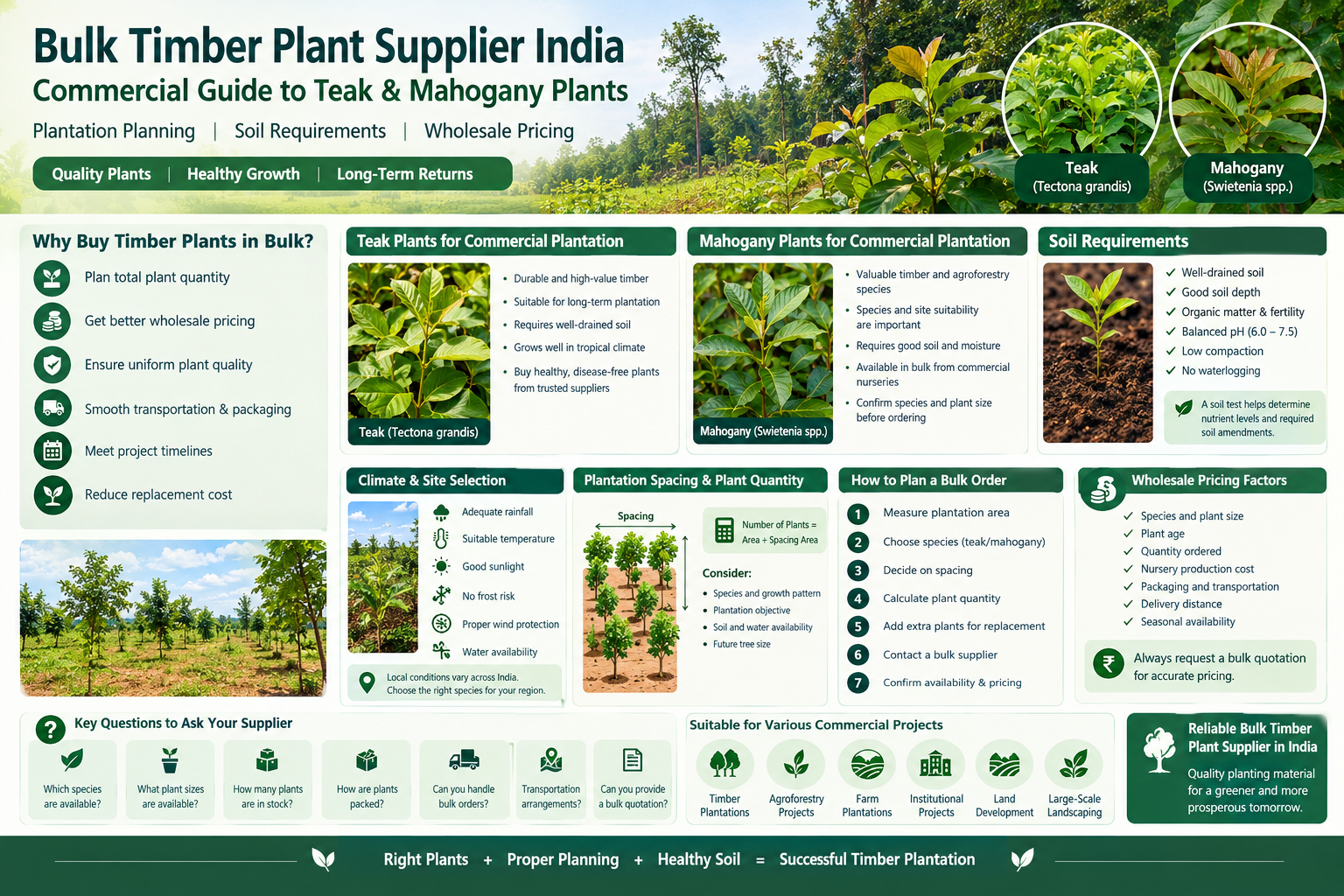
Why Buy Timber Plants in Bulk?
Commercial plantations may require hundreds or thousands of plants. Purchasing plants individually from retail nurseries can make procurement more difficult and inconsistent.
Bulk procurement allows buyers to plan:
- Required plant quantity
- Planting season
- Plant size
- Transportation
- Packaging
- Plantation spacing
- Replacement plants
- Project timelines
- Overall procurement costs
A commercial nursery supplying timber plants in bulk can also help buyers coordinate plant availability according to their plantation schedule.
For large projects, it is important to discuss the required species, quantity, plant size, delivery location and expected planting date with the nursery before confirming an order.
Teak Plants for Commercial Plantation
Teak, botanically known as Tectona grandis, is a well-known tropical hardwood species. It is valued for its durable timber and is cultivated in several parts of India.
Teak plantations are generally considered for long-term timber production rather than short-term returns. Therefore, plantation planning should begin with realistic expectations about the time required for trees to mature.
When purchasing teak plants in bulk, buyers should pay attention to:
- Healthy and vigorous plants
- Uniform plant size
- Suitable planting material
- Root development
- Freedom from visible pests and diseases
- Nursery handling practices
- Transportation conditions
The quality of planting material can have an important effect on plantation establishment.
Mahogany Plants for Commercial Plantation
Mahogany is another valuable timber group used in plantation and agroforestry contexts. Different mahogany species and planting materials can have different environmental requirements, so buyers should confirm the exact species before placing a large order.
A commercial buyer should discuss the following with the nursery:
- Exact mahogany species
- Plant age or size
- Growing conditions
- Suitable climate
- Soil requirements
- Recommended spacing
- Availability in bulk
- Transportation arrangements
Selecting the appropriate planting material for the local environment is more important than simply choosing a species based on its commercial reputation.
Soil Requirements for Timber Plantation
Soil is one of the most important factors when planning a commercial timber plantation.
Before planting teak, mahogany or other timber species, the land should ideally be evaluated for:
- Soil type
- Drainage
- Soil depth
- Organic matter
- Soil fertility
- Moisture availability
- pH
- Compaction
- Waterlogging risk
Many timber trees perform better in well-drained soil because prolonged waterlogging can negatively affect root development.
Heavy or compacted soil may require appropriate land preparation before plantation establishment.
A soil test can provide useful information about nutrient levels and pH and can help determine whether soil amendments are required.
Why Drainage Matters
One common mistake in plantation planning is focusing only on soil fertility.
Even fertile soil may not be suitable if water remains stagnant around the roots for long periods.
Before purchasing thousands of timber plants, inspect the plantation site and understand its drainage characteristics, especially during the rainy season.
Climate and Site Selection
Teak and mahogany are tropical timber species, but their performance depends on local environmental conditions.
Before establishing a plantation, consider:
- Annual rainfall
- Temperature
- Sunlight
- Dry periods
- Frost risk
- Wind exposure
- Irrigation availability
- Local soil conditions
The same planting strategy should not automatically be applied to every region of India.
For example, plantation planning in Uttar Pradesh may differ from planning in Gujarat, Madhya Pradesh, Rajasthan, Haryana or other regions because climate, soil and water availability can vary considerably.
A local agricultural or forestry professional can help determine whether a particular timber species is appropriate for a specific site.
Plantation Spacing and Plant Quantity
Planting density should be decided according to the species, plantation objective, soil conditions, management system and expected tree development.
A simple calculation is:
Number of Plants = Plantation Area ÷ Area Allocated per Plant
For example, if a plantation uses a particular spacing, the total number of plants required can be estimated from the available planting area.
However, commercial plantation spacing should not be selected only to maximize the number of plants.
Trees require sufficient growing space for:
- Root development
- Canopy development
- Light availability
- Nutrient access
- Management operations
- Future growth
For this reason, plantation spacing should be finalized according to the species and professional plantation recommendations.
How to Plan a Bulk Timber Plant Order
A commercial buyer should estimate the required quantity before contacting a nursery.
A practical procurement process can be:
Step 1: Measure the Plantation Area
Determine the total land available for planting.
Step 2: Select the Timber Species
Decide whether teak, mahogany or another species is appropriate for the site and plantation objective.
Step 3: Determine Planting Spacing
Select an appropriate spacing based on the plantation system.
Step 4: Calculate Plant Quantity
Estimate the number of plants required.
Step 5: Add Replacement Plants
It can be useful to account for a small number of additional plants for replacement after establishment, depending on the project plan.
Step 6: Contact a Bulk Timber Plant Supplier
Provide the nursery with:
- Required species
- Quantity
- Plant size
- Delivery location
- Expected planting date
- Packaging requirements
Step 7: Confirm Availability and Pricing
Request a commercial quotation based on the actual quantity and delivery requirements.
Wholesale Pricing of Teak and Mahogany Plants
The wholesale price of timber plants is not necessarily the same for every order.
Pricing can depend on:
- Plant species
- Plant size
- Plant age
- Quantity ordered
- Nursery production cost
- Pot or bag size
- Packaging
- Transportation
- Delivery distance
- Seasonal availability
- Project requirements
For this reason, a commercial buyer should request a bulk quotation rather than relying on a general retail plant price.
Large orders may also require customized packaging and transportation arrangements.
A professional nursery should provide buyers with clear information about what is included in the quoted price.
What Should You Ask a Bulk Timber Plant Supplier?
Before placing a large order, buyers should ask the nursery several important questions.
1. Which species are available?
Confirm the exact botanical species instead of relying only on common names.
2. What plant sizes are available?
Plant size can influence transportation, handling and plantation establishment.
3. How many plants are currently available?
For large plantations, availability should be confirmed before finalizing the project schedule.
4. How are plants packed?
Proper packaging can help reduce damage during transportation.
5. Can the nursery handle bulk orders?
A supplier should be able to communicate realistic quantities and timelines.
6. What is the transportation arrangement?
For large orders, logistics can represent an important part of the overall procurement cost.
7. Can the nursery provide a bulk quotation?
Ask for pricing based on the actual quantity, plant size and destination.
Choosing Healthy Timber Plants for Plantation
The quality of planting material is important during plantation establishment.
When receiving a bulk order, buyers should inspect plants for obvious signs of poor health.
Look for:
- Healthy foliage
- Strong stems
- Well-developed roots
- Good overall vigour
- Uniform growth
- No obvious pest infestation
- No major physical damage
- Properly established root systems
Plants should also be handled carefully during loading, transportation and unloading.
A healthy nursery plant still requires proper planting and aftercare to establish successfully at the plantation site.
Bulk Timber Plant Supply for Different Commercial Projects
Timber plants may be purchased for different types of projects.
These can include:
- Commercial timber plantations
- Agroforestry projects
- Farm plantations
- Institutional plantations
- Land development projects
- Long-term forestry projects
- Private plantation projects
- Large-scale landscaping and green development projects
The required species, quantity and management system can differ between projects.
Therefore, commercial buyers should define their plantation objective before ordering plants.
Timber Plant Supply Across India
India has diverse climatic and soil conditions, so timber plantation planning should be location-specific.
A bulk timber plant supplier in India may serve buyers in different states, but the buyer should confirm whether the selected species is suitable for the intended location.
Regions such as:
- Uttar Pradesh
- Madhya Pradesh
- Haryana
- Rajasthan
- Gujarat
- Chhattisgarh
can have substantially different local growing conditions.
Rather than selecting plants only because they are commercially popular, buyers should evaluate the plantation site, soil, water availability and climate first.
Why Nursery Quality Matters in Commercial Plantation
A commercial plantation represents a long-term investment. The initial plant purchase is only one part of the total plantation cost.
Poor-quality planting material can increase:
- Replacement requirements
- Labour requirements
- Establishment problems
- Plant mortality
- Project delays
Buying from a nursery experienced in commercial and bulk plant supply can make procurement more organized.
However, buyers should still inspect planting material and verify species and quantity before accepting a large shipment.
Teak vs Mahogany: What Should Commercial Buyers Consider?
The decision between teak and mahogany should not be based only on expected timber value.
Consider:
| Factor | Teak | Mahogany |
|---|---|---|
| Plantation objective | Long-term timber production | Timber/agroforestry applications |
| Site suitability | Depends on local conditions | Depends on species and local conditions |
| Soil | Prefer suitable, well-drained soil | Site-specific |
| Water management | Important | Important |
| Plantation period | Long-term | Long-term |
| Bulk procurement | Available through commercial nurseries | Available depending on species and nursery |
| Key consideration | Site and plantation management | Correct species and site suitability |
Before making a commercial decision, buyers should evaluate local conditions and obtain professional forestry/agricultural guidance where necessary.
Conclusion
Successful commercial timber plantation begins before the plants reach the field.
Choosing the appropriate species, evaluating soil and drainage, understanding climate conditions, calculating plant requirements and purchasing healthy planting material are all important steps in plantation planning.
For businesses and landowners looking for a bulk timber plant supplier in India, the best approach is to share the complete project requirement with the nursery, including species, quantity, plant size, delivery location and expected planting schedule.
Whether the requirement is for teak plants, mahogany plants or other commercial timber species, a properly planned bulk purchase can make large-scale plantation establishment more organized and efficient.
The right planting material, combined with suitable site preparation and long-term plantation management, provides a stronger foundation for a commercial timber plantation.
Frequently Asked Questions
Where can I buy teak plants in bulk in India?
Teak plants can be purchased from commercial nurseries and plant suppliers that handle wholesale or bulk orders. Buyers should confirm species, quantity, plant size, availability, transportation and bulk pricing before placing an order.
How much do teak and mahogany plants cost in bulk?
Bulk pricing varies according to species, plant size, quantity, packaging, transportation and location. Commercial buyers should request a customized quotation based on their actual requirement.
What soil is suitable for teak plantation?
Teak generally performs best in suitable, well-drained soils with adequate fertility and moisture. A soil test and local site assessment can help determine whether the land is appropriate.
What should I check before buying timber plants in bulk?
Check the exact species, plant health, root development, plant size, quantity, nursery availability, packaging, transportation arrangements and commercial quotation.
Is teak or mahogany better for commercial plantation?
There is no universally better option. The appropriate species depends on the plantation objective, climate, soil, water availability, local conditions and long-term management plan.